
cveenumerationvulnerablities
cve-search - a tool to perform local searches for known vulnerabilities
Umut
October 24, 2017
0 comments

cve-search is a tool to import CVE (Common Vulnerabilities and Exposures) and CPE (Common Platform Enumeration) into a MongoDB to facilitate search and processing of CVEs.
The main objective of the software is to avoid doing direct and public lookup into the public CVE databases. This is usually faster to do local lookups and limits your sensitive queries via the Internet.
cve-search includes a back-end to store vulnerabilities and related information, an intuitive web interface for search and managing vulnerabilities, a series of tools to query the system and a web API interface.
cve-search is used by many organizations including the public CVE services of CIRCL.
Requirements
- Python3.3 or later
- MongoDB 2.2 or later
- redis server
- Pip3
- PyMongo
- Flask
- Flask-PyMongo
- Flask-Login
- Tornado
- Whoosh
- Redis
- Python-dateutil
- passlib
- feedformater (for RSS and Atom dump_last) http://code.google.com/p/feedformatter/
- Whoosh http://packages.python.org/Whoosh/ (If you're planning to use the Full-text indexer)
- irc
- sleekxmpp
- Werkzeug
- Jinja2
- itsdangerous
- click
The requirements can be installed with pip:
sudo pip3 install -r requirements.txt
Installation of MongoDB
First, you'll need to have a Python 3 installation (3.3 or higher). Then you need to install MongoDB (2.2) from source (this should also work with any standard packages from your favorite distribution). Don't forget to install the headers for development while installing MongoDB. You can go to http://docs.mongodb.org/manual/installation/ for to get the packages for your distribution, or http://www.mongodb.org/downloads for the source code.
Populating the database
For the initial run, you need to populate the CVE database by running:
./sbin/db_mgmt.py -p
./sbin/db_mgmt_cpe_dictionary.py
./sbin/db_updater.py -c
It will fetch all the existing XML files from the Common Vulnerabilities and Exposures database and the Common Platform Enumeration. The initial Common Platform Enumeration (CPE) import might take some time depending of your configuration.
If you want to add the cross-references from NIST, Red Hat and other vendors:
./sbin/db_mgmt_ref.py
A more detailed documentation can be found in the Documentations folder of the project.
Databases and collections
The MongoDB database is called cvedb and there are 11 collections:
- cves (Common Vulnerabilities and Exposure items) - source NVD NIST
- cpe (Common Platform Enumeration items) - source NVD NIST
- cwe (Common Weakness Enumeration items) - source NVD NIST
- capec (Common Attack Pattern Enumeration and Classification) - source NVD NIST
- ranking (ranking rules per group) - local cve-search
- d2sec (Exploitation reference from D2 Elliot Web Exploitation Framework) - source d2sec.com
- MITRE Reference Key/Maps - source MITRE reference Key/Maps
- ms - (Microsoft Bulletin (Security Vulnerabilities and Bulletin)) - source Microsoft
- exploitdb (Offensive Security - Exploit Database) - source offensive security
- info (metadata of each collection like last-modified) - local cve-search
- via4 VIA4CVE cross-references.
The Redis database has 3 databases:
- 10: The cpe (Common Platform Enumeration) cache - source MongoDB cvedb collection cpe
- 11: The notification database - source cve-search
- 12: The CVE reference database is a cross-reference database to CVE ids against various vendors ID - source NVD NIST/MITRE
The reference database has 3 additional sources:
- MITRE Reference Key/Maps.
- Red Hat RPM to CVE database.
- Red Hat RHSA Oval database.
Updating the database
An updater script helps to start the db_mgmt_*
./sbin/db_updater.py -v
You can run it in a crontab, logging is done in syslog by default.
Repopulating the database
To easily drop and re-populate all the databases
./sbin/db_updater.py -v -f
This will drop all the existing external sources and reimport everything. This operation can take some time and it's usually only required when new attributes parsing are added in cve-search.
Usage
You can search the database using search.py
./bin/search.py -p cisco:ios:12.4
./bin/search.py -p cisco:ios:12.4 -o json
./bin/search.py -f nagios -n
./bin/search.py -p microsoft:windows_7 -o html
If you want to search all the WebEx vulnerabilities and only printing the official references from the supplier.
./bin/search.py -p webex: -o csv -v "cisco"
You can also dump the JSON for a specific CVE ID.
./bin/search.py -c CVE-2010-3333
Or you can use the XMPP bot
./bin/search_xmpp.py -j mybot@jabber.org -p strongpassword
Or dump the last 2 CVE entries in RSS or Atom format
./bin/dump_last.py -f atom -l 2
Or you can use the webinterface.
./web/index.py
Usage of the ranking database
There is a ranking database allowing to rank software vulnerabilities based on their common platform enumeration name. The ranking can be done per organization or department within your organization or any meaningful name for you.
As an example, you can add a partial CPE name like "sap:netweaver" which is very critical for your accounting department.
./sbin/db_ranking.py -c "sap:netweaver" -g "accounting" -r 3
and then you can lookup the ranking (-r option) for a specific CVE-ID:
./bin/search.py -c CVE-2012-4341 -r -n
Advanced usage
As cve-search is based on a set of tools, it can be used and combined with standard Unix tools. If you ever wonder what are the top vendors using the term "unknown" for their vulnerabilities:
python3 bin/search_fulltext.py -q unknown -f | jq -c '. | .vulnerable_configuration[0]' | cut -f5 -d: | sort  | uniq -c  | sort -nr | head -10

1500 oracle
381 sun
372 hp
232 google
208 ibm
126 mozilla
103 microsoft
100 adobe
 78 apple
 68 linux
You can compare CVSS (Common Vulnerability Scoring System ) values of some products based on their CPE name. Like comparing oracle:java versus sun:jre and using R to make some statistics about their CVSS values:
python3 bin/search.py -p oracle:java -o json  | jq -r '.cvss' | Rscript -e 'summary(as.numeric(read.table(file("stdin"))[,1]))'
Min. 1st Qu.  Median    Mean 3rd Qu.    Max.
1.800   5.350   9.300   7.832  10.000  10.000


python3 bin/search.py -p sun:jre -o json  | jq -r '.cvss' | Rscript -e 'summary(as.numeric(read.table(file("stdin"))[,1]))'
Min. 1st Qu.  Median    Mean 3rd Qu.    Max.
0.000   5.000   7.500   7.333  10.000  10.000
Fulltext indexing
If you want to index all the CVEs from your current MongoDB collection:
./sbin/db_fulltext.py
and you query the fulltext index (to get a list of matching CVE-ID):
./bin/search_fulltext.py -q NFS -q Linux
or to query the fulltext index and output the JSON object for each CVE-ID:
./bin/search_fulltext.py -q NFS -q Linux -f
Fulltext visualization
The fulltext indexer visualization is using the fulltext indexes to build a list of the most common keywords used in CVE. NLTK is required to generate the keywords with the most common English stopwords and lemmatize the output. NTLK for Python 3exists but you need to use the alpha version of NLTK.
./bin/search_fulltext.py -g -s >cve.json
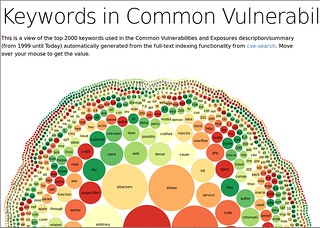
You can see a visualization on the demo site.
Web interface
The web interface is a minimal interface to see the last CVE entries and query a specific CVE. You'll need flask in order to run the website and Flask-PyMongo. To start the web interface:
cd ./web
./index.py
Then you can connect on http://127.0.0.1:5000/ to browser the last CVE.
Web API interface
The web interface includes a minimal JSON API to get CVE by ID, by vendor or product. A public version of the API is also accessible on cve.circl.lu.
List the know vendors in JSON
curl http://127.0.0.1:5000/api/browse/
Dump the product of a specific vendor in JSON
curl  http://127.0.0.1:5000/api/browse/zyxel
{
  "product": [
    "n300_netusb_nbg-419n",
    "n300_netusb_nbg-419n_firmware",
    "p-660h-61",
    "p-660h-63",
    "p-660h-67",
    "p-660h-d1",
    "p-660h-d3",
    "p-660h-t1",
    "p-660h-t3",
    "p-660hw",
    "p-660hw_d1",
    "p-660hw_d3",
    "p-660hw_t3"
  ],
  "vendor": "zyxel"
}
Find the associated vulnerabilities to a vendor and a product
curl  http://127.0.0.1:5000/api/search/zyxel/p-660hw
[{"cwe": "CWE-352", "references": ["http://www.exploit-db.com/exploits/33518", "http://secunia.com/advisories/58513", "http://packetstormsecurity.com/files/126812/Zyxel-P-660HW-T1-Cross-Site-Request-Forgery.html", "http://osvdb.org/show/osvdb/107449"], "vulnerable_configuration": ["cpe:/h:zyxel:p-660hw:_t1:v3"], "Published": "2014-06-16T14:55:09.713-04:00", "id": "CVE-2014-4162", "Modified": "2014-07-17T01:07:29.683-04:00", "cvss": 6.8, "summary": "Multiple cross-site request forgery (CSRF) vulnerabilities in the Zyxel P-660HW-T1 (v3) wireless router allow remote attackers to hijack the authentication of administrators for requests that change the (1) wifi password or (2) SSID via a request to Forms/WLAN_General_1."}, {"cwe": "CWE-20", "references": ["http://www.kb.cert.org/vuls/id/893726"], "vulnerable_configuration": ["cpe:/h:zyxel:p-660h-63:-", "cpe:/h:zyxel:p-660h-t1:-", "cpe:/h:zyxel:p-660h-d3:-", "cpe:/h:zyxel:p-660h-t3:v2", "cpe:/h:zyxel:p-660h-t1:v2", "cpe:/h:zyxel:p-660h-d1:-", "cpe:/h:zyxel:p-660h-67:-", "cpe:/h:zyxel:p-660h-61:-", "cpe:/h:zyxel:p-660hw_t3:v2", "cpe:/h:zyxel:p-660hw_t3:-", "cpe:/h:zyxel:p-660hw_d3:-", "cpe:/h:zyxel:p-660hw_d1:v2", "cpe:/h:zyxel:p-660hw_d1:-", "cpe:/h:zyxel:p-660hw:_t1:v2", "cpe:/h:zyxel:p-660hw:_t1:-"], "Published": "2014-04-01T23:58:16.967-04:00", "id": "CVE-2013-3588", "Modified": "2014-04-02T11:29:53.243-04:00", "cvss": 7.8, "summary": "The web management interface on Zyxel P660 devices allows remote attackers to cause a denial of service (reboot) via a flood of TCP SYN packets."}, {"cwe": "CWE-79", "references": ["http://osvdb.org/ref/99/rompager407.pdf", "http://osvdb.org/99694", "http://antoniovazquezblanco.github.io/docs/advisories/Advisory_RomPagerXSS.pdf"], "vulnerable_configuration": ["cpe:/h:d-link:dsl-2640r:-", "cpe:/h:d-link:dsl-2641r:-", "cpe:/h:huawei:mt882:-", "cpe:/h:sitecom:wl-174:-", "cpe:/h:tp-link:td-8816:-", "cpe:/a:allegrosoft:rompager:4.07", "cpe:/h:zyxel:p-660hw_d1:-"], "Published": "2014-01-16T14:55:04.607-05:00", "id": "CVE-2013-6786", "Modified": "2014-01-17T11:01:47.353-05:00", "cvss": 4.3, "summary": "Cross-site scripting (XSS) vulnerability in Allegro RomPager before 4.51, as used on the ZyXEL P660HW-D1, Huawei MT882, Sitecom WL-174, TP-LINK TD-8816, and D-Link DSL-2640R and DSL-2641R, when the \"forbidden author header\" protection mechanism is bypassed, allows remote attackers to inject arbitrary web script or HTML by requesting a nonexistent URI in conjunction with a crafted HTTP Referer header that is not properly handled in a 404 page.  NOTE: there is no CVE for a \"URL redirection\" issue that some sources list separately."}, {"cwe": "CWE-79", "references": ["http://xforce.iss.net/xforce/xfdb/41109", "http://www.securityfocus.com/archive/1/archive/1/489009/100/0/threaded", "http://www.gnucitizen.org/projects/router-hacking-challenge/"], "vulnerable_configuration": ["cpe:/h:zyxel:p-660hw_t3:v2", "cpe:/h:zyxel:p-660hw:_t1:v2", "cpe:/h:zyxel:p-660hw_d1:v2", "cpe:/h:zyxel:p-660hw_t3:-", "cpe:/h:zyxel:p-660hw:_t1:-", "cpe:/h:zyxel:p-660hw_d3:-", "cpe:/h:zyxel:p-660hw_d1:-"], "Published": "2008-03-10T13:44:00.000-04:00", "id": "CVE-2008-1257", "Modified": "2012-05-31T00:00:00.000-04:00", "cvss": 4.3, "summary": "Cross-site scripting (XSS) vulnerability in Forms/DiagGeneral_2 on the ZyXEL P-660HW series router allows remote attackers to inject arbitrary web script or HTML via the PingIPAddr parameter."}, {"id": "CVE-2008-1256", "references": ["http://xforce.iss.net/xforce/xfdb/41108", "http://www.securityfocus.com/archive/1/archive/1/489009/100/0/threaded", "http://www.gnucitizen.org/projects/router-hacking-challenge/"], "vulnerable_configuration": ["cpe:/h:zyxel:p-660hw"], "Published": "2008-03-10T13:44:00.000-04:00", "Modified": "2011-03-07T22:06:25.080-05:00", "cvss": 10.0, "summary": "The ZyXEL P-660HW series router has \"admin\" as its default password, which allows remote attackers to gain administrative access."}, {"cwe": "CWE-264", "references": ["http://www.securityfocus.com/archive/1/archive/1/489009/100/0/threaded", "http://www.gnucitizen.org/projects/router-hacking-challenge/", "http://xforce.iss.net/xforce/xfdb/41114"], "vulnerable_configuration": ["cpe:/h:zyxel:p-660hw"], "Published": "2008-03-10T13:44:00.000-04:00", "id": "CVE-2008-1255", "Modified": "2008-09-05T17:37:15.440-04:00", "cvss": 10.0, "summary": "The ZyXEL P-660HW series router maintains authentication state by IP address, which allows remote attackers to bypass authentication by establishing a session from a source IP address of a previously authenticated user."}, {"cwe": "CWE-352", "references": ["http://www.securityfocus.com/archive/1/archive/1/489009/100/0/threaded", "http://www.gnucitizen.org/projects/router-hacking-challenge/", "http://xforce.iss.net/xforce/xfdb/41111"], "vulnerable_configuration": ["cpe:/h:zyxel:p-660hw"], "Published": "2008-03-10T13:44:00.000-04:00", "id": "CVE-2008-1254", "Modified": "2008-09-05T17:37:15.287-04:00", "cvss": 6.8, "summary": "Multiple cross-site request forgery (CSRF) vulnerabilities on the ZyXEL P-660HW series router allow remote attackers to (1) change DNS servers and (2) add keywords to the \"bannedlist\" via unspecified vectors."}]
Software using cve-search
- cve-portal which is a CVE notification portal
- cve-search-mt which is a set of management tools for CVE-Search
- cve-scan which is a NMap CVE system scanner
Ad